

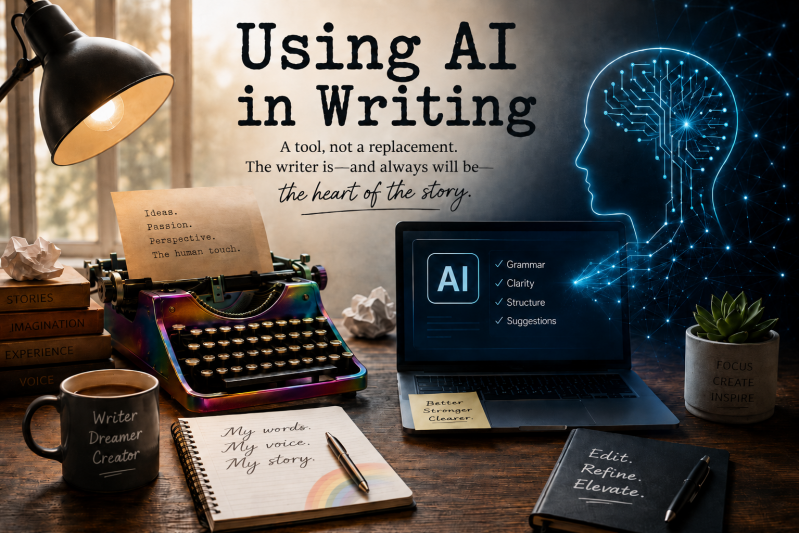
Here's two versions of my article on AI in Writing. The one on the left (in mobile the 1st one) is 100% mine. It is a rough draft. I didn't edit it. I didn't go back through and proofread it. As a matter of fact, I didn't read through it completely until I posted it on here. It's 100% the unadulterated first draft of the article that I wrote this morning.
The one on the right (in mobile the second one) is AI. I put the entire article in ChatGPT with only one instruction: Polish this passage. That's it.
My version is 3007 words. AI's version is 1832 words. Apparently, I'm a bit more wordy than AI. Maybe in another article I can analyze all the other differences.
Using AI in Writing (my version)
There’s a ton of very critical, sometimes to a disturbing level, online about the use of AI in writing, in music, in video posting. Let’s be real. AI is everywhere. And it’s not going away. It’s only going to get worse or better depending upon how you look at it.
There’s nothing worse than a video popping up and blasting us with terrible AI that the audio doesn’t sync with the video or the visuals are so bad that it’s nauseating. I get it. AI can be terrible. It doesn’t always judge our words properly. It doesn’t always read the room right. When we use it to create seomtimes it just plain gets it wrong.
The internet has become so overly saturated with AI that I can certainly understand why so many are absolutely against using AI for anything in the writing process. I get it. You can tell right away when soemtning is AI written or AI influenced. But is there a benefit of AI in writing? That’s the question I want to ask today.
Those that are overly critical of it don’t feel at all against a writer using an editor to polish their books or articles. No even a second thought. So, what’s the difference. Well… there is a difference. But let’s talk about why anyone would use AI at all.
I love to write. I have always been a writer at heart starting as a little boy in my bedroom. We were very poor growing up. I didn’t always have the best things in life. My dad worked hard and he always made sure we were taken care of, well fed, and had a roof over our heads. But the luxuries of life we missed out on so often. We never went to movies because we were a family of five and never had the money. A trip to McDonald’s was a super special occation because paying for five people wasn’t the same as buying a lunch on the go for one. I learned that real quick when I had my own kids. A lunch could go from $5 to $25 real quick. Adjusting for inflation $15 to $100.
When I was a preteen, my bedroom was a converted basement. My dad built the walls and the floor himself. And he was no carpenter, mind you, but it served its’ purpose and I didn’t care. Not one time did I look at my bedroom and think how awful the craftsmenship was. Because I respected my dad and loved him very much. He put so much effort into it that I just appreciated what he gave me.
My bedroom was pretty small. It was made up of one full bed and a dresser that was so close to my bed I could sit up, hang my legs off my bed and my knees would touch the dresser draws when opened. Those days were golden.
I didn’t have a desk. So, I improvised. The top sock drawer in my red dresser was pretty small but wide. I got the idea one day after wrestling with trying to write in my bed with nothing but a pillow and a notebook to turn that sock drawer upside down and use the bottom of the drawer as a hard surface. I placed my notebooks on top and scotched my bed must a bit closer and tada… I had a desk. That makeshift desk became my escape hatch from my world. I wrote tons of stupid, silly stories that would never see the light of a published platform, ever. And if anyone read those stories I’d be so embarrassed I’d probably never show my face to any social media ever again. As if I do now anyway.
As I write, I have some strong points and I have some weak points and I have some super bad habits. We all do. I’m terrible at editing and making sure things sound right. I am awful at grammar. Did I use that comma right? Did that need a semicolon or just a comma? Did that sentence flow right or is it too messy? These are all questions that I normally can’t answer correctly. I struggled and struggled with all of those things.
I am not in the position as a writer to hire an editor so I had to do it all myself. Boy, can you tell. Before I discovered the use of AI in the editing process I would write. Finish a project then take the tedious task of going bak over it line by line to make sure there were no misspellings or sentence structure issues. God, was that awful. Every writer will tell you that’s the part of the process that we hate the most.
Of course, I use Microsoft Word and even back in the 90s we had spell correct and later grammar correct. I utilized it but it was far from perfect. It would mis things and it would correct something that shouldn’t have been corrected. But it was fine for what it was. Still, those utilities would never change the writing style or the function of what the writer was trying to convey. Here is where AI does it wrong. Or, at least, where some “writers” misuse AI. I, myself, got caught up in it for a bit because I thought… Oh, AI knows better what I’m trying to say. God, no it does not.
I started using AI to assist me in writing about a year ago. I found that it helped smooth out sentence structure and paragraph usage and keep the grammar police off my back. But let me go back in time just a little further.
I wrote my first novel, Inside Out, back in 2021. I completed it around the end of that year. I let it sit on my computer for along time. It ended at app. 95,000 words and 320 pages. I was so proud of that end product, but I was terrified to put it out for other people to see. I had never done that before. I had never let anyone read my material because I was convinced I was terrible at writing. I was just doing it because I loved doing it so much. Now that manuscript of Inside Out back then was 100% written by me. I didn’t use AI at all. I don’t think AI even existed in the capacity that it does today. I could be wrong. But I only used the spell/grammar check in Word.
So, now I use AI for editing purposes. I would never use AI to write out an entire article or novel. To me that seems like you’re taking away the style of interpretation of the writer. So, let me explain my writing process and my thought process in using AI in my writing.
Some would say that if you use AI anywhere in the process it’s not your writing at all. To me it’s no different than writing something whether it be an article or a novella or a novel or an essay and you run to an editor to proofread and offer suggestions to make the piece better. Every writer does this. From Stephen King to the lowliest of lows like myself. We all use some form of editing assistance.
And then you have a ghost writer. This is where a published work is attributed to one person but another person does all or most of the writing, structuring, polishing, editing, and plot formation. This is a common practice and is usually done when the person that the authorship is attributed to is not normally a writer such as a celebrity, an athlete, a politician, etc. Sometimes the person collaborates. Sometimes they do nothing except give insight and history for the actual writer to put a plot and/or material together.
Here’s my process. I will get an idea. I always have ideas. They run around in my head all the time. It’s almost always associated with something that has happened to me in my own personal life. It’s almost always horror or gay related in som way. That’s because that’s my niche. That’s what I relate to most. Writers don’t always but most of the time write about things they know. And the things you don’t know you research and develop. That can be tricky, because if I’m not familiar with a specific subject or material I will not pick up on the nuances or the genuine feel of that particular subject. I’ll still write it but it may not come out exactly perfect or with an authentic feel.
Let me give you an example. I’ve never been a fire fighter. I’ve never wanted to be. I’ve never known a fire fighter personally or intimately. I have a great deal of respect for them and we couldn’t function as a society without them. In my line of work, I’ve spoken to a great many fire fighters, but to really dig into their life and their work I have never done.
That being said, if I were to write something in regards to a fire fighter I would rely heavily on research and interviews. That means that if I were to write on it I wouldn’t necessarily pick up on small, important details that a fire fighter would recognize immediately. It doesn’t make the writing bad, but it does make the story feel less real, less authentic. As a writer, we can’t know everything about everything. That’s not humanly possible, but we can research and discuss the material with someone that may know more about it. Still, no matter how much research you put into it you may get things wrong. No big deal. It’s part of the process.
A great example of this is in my book Goose and Scepter. I wanted Miles to be a powerful influence in the community because I felt that it added to the dynamic between Chase and Miles. But I wrestled for many weeks and even months at exactly what Miles’s carreer would be. I didn’t really even know until I’d already write about four or five chapters. I had to go back and tweak the story to accommodate that little detail. I don’t know the first thing about real estate. I work in healthcare. I’ve never had any real conversations with a real estate agent except for the few that I had when I bought my house. I’ve never even sold anything through a real estate agent. I did get some exposure when James’s (my fiancé) mom died a few years ago in probate and inheritance. But beyond that, I had no clue what to say.
So I went to the internet before I even started looking at ChatGPT or Copilot or any AI for that matter. I read up on some things but never got a good feel for what I was looking for. So, I pulled up Copilot. I already had a service through Microsoft 365 so it was free and I din’t even know it existed until that moment. It kept popping up informing me about its service and I kept closing it because I didn’t really think I’d need it. One day I gave it a whirl and ran some questions about real estate in it. The answers it gave me, quite frankly, were a bit odd. I wasn’t sold instantly. But because I was desparate to figure out how I was going to place this in my novel I forged ahead. Finally, it gave me some assistance that made sense and seemed like it meshed with my story.
So, I wrote a passage directly related to real estate and how Miles responded to something. Then I ran that whole passage. It was probably just a couple pages. Copilot has a bad restriction on that amount of characters you can use. Or, at least they used to. I haven’t used Copilot in quite awhile so they may have changed that. So, it wasn’t much. I asked Copilot to tell me if what I wrote made sense in the real estate world. When I did that my writing process changed in an instant.
Copilot offered me suggestions and told me where I was wrong and where I was right. I fixed what it suggested and I thought… I can do this in so many other things that I struggle in as well. So, I wrote out a few more pages. I believe it was the interaction between Malhotra and Miles and I asked Copilot to run a grammar check, fix any misspellings because I get to typing too fast sometimes, and to give me any suggestions on the flow of the passage. BAM! Copilot gave me a suggestion and it didn’t make sense to me so I didn’t go with it all, but there was a section that it corrected that I thought… OH MY GOD I love that word you used. We will stick with that word.
So, from there I put in every page from the novel that I had at the time and did the same process. Some things I accepted. Other things I absolutely said NO WAY. But when it came to the board meetings in Goose I realized I couldn’t write it. I tried many times and none of it made sense to me and I was afraid it would come off as silly and misinformed. So, I pulled up Copilot and asked it to run a board meeting between Miles and his board members and I inputed the specifics about the situation and Copilot spit out a, roughly, two-page scene. I proofed it. It sounded good and it fit with where I was putting it in the novel and so I used it.
Now, some of you will automatically say… Yuck. He used AI. I will never read his material ever. I respect that decision. No hard feelings. I understand. I’m not the world’s greatest writer and I never will be. You do not have to read my material. You can scroll past my articles. You can do whatever you like. Won’t hurt my feelings in the least.
What I hope this article will do is get people to think about what AI can do in the writing process that might be a benefit without losing your style and voice. There are places in Dark Echoes that I may have relied on AI a bit too much. Not that I didn’t write it. Because I actually wrote the entire novella without any AI at all but, after I finished Goose, I went back and ran Dark Echoes through AI to fix some things I didn’t like and I think I may have used too much AI to do the corrections. I may go back and rewrite some of the particular points in the story that I shouldn’t have changed. Dark Echoes is most certainly the most personal of my stories because Joshua is me. That story is my life with a few exceptions. My mom was not as severe as that woman was. But the mask, the hiding, the shame, the fear, the torment, that beast that Joshua created inside himself-- was all real inside me. It took decades to get that out and I’m still working on it.
I say that to say this: I most certainly wrote Dark Echoes. I wrote every word, every page; but after I published Goose I wanted to polish it up so that it was more professional. My greatest weakness in writing is grammar and sentence structure. I don’t enjoy that aspect of writing. My love for writing is in the plot, the characters, the story. I fall in love with my characters. I fall in love with the process of manipulating the story and the characters in such a way that can be entertaining, uplifting, and even tramatic at times. That’s where I really enjoy to delve into. But the other aspects of writing can become a bit burdensome and tedious. It is what it is. I use AI to help me in my weak points so that my strengths (if I have any) can shine better. Some would say since I use AI at all that I’m not a writer. Sure. If that makes you feel better go for it. But I hope that the stories I tell can still impact people in a positive way. Because, ultimately, that’s why I write now. When I was a kid I wrote just to escape. I hated myself so bad that I could never do anything right. To me anyway. Writing helped me in that it created characters I wanted to be. Back then all of my characters were straight and popular and free. That’s what I wanted so bad. Writing, for me back then, gave me some form of therapy because it was the 80s. I wasn’t going to get any therapy. The only therapy we got back then was “Suck it up. Be a man. And wipe dirt on it.”
AI has its place now whether we like it or not. Is there a negative side? Absolutely. But I think blasting folks that use AI at all is probably too far to wrong side of the road. I think AI can be used as a tool to aide in writing. To pop in a couple sentences of a description and ask ChatGPT to give you a 150,000 word novel… Now that’s a bit too far. ChatGPT is basically your ghostwriter at that point. And if that’s what you’re looking for go for it. But probably put a disclaimer on there somewhere. When I publish through Amazon it asks about AI usage and I’m completely honest about what role AI has been in my work.
I’m sure there’s a ton of feelings out there about what’s too much or what’s not enough. But in expressing those feelings maybe we should understand that not every situation is the same.
Using AI in Writing (AI version)
There’s a lot of criticism online about the use of AI in writing, music, video creation—pretty much every creative field imaginable. Some of that criticism is fair. Some of it gets a little extreme. But let’s be honest: AI is here, and it’s not going anywhere. Whether that’s a good thing or a bad thing depends entirely on how you choose to look at it.
We’ve all seen terrible AI content. Videos where the audio doesn’t sync. Images so distorted they’re uncomfortable to look at. Writing that feels robotic, lifeless, or painfully obvious. AI can absolutely miss the mark. It doesn’t always understand tone, emotion, or nuance. Sometimes it completely misreads what we’re trying to say.
And yes, the internet has become oversaturated with AI-generated material. I completely understand why so many people push back against it, especially in writing. Most readers can immediately tell when something feels overly AI-influenced. But that raises a question I think is worth asking:
Can AI still have a legitimate place in the writing process?
People who strongly oppose AI usually have no problem with writers hiring editors to polish their novels, articles, or essays. Nobody bats an eye at that. Now, to be fair, there is a difference between editing and AI. But before we get into that, I think it’s important to talk about why some writers use AI in the first place.
I’ve loved writing for as long as I can remember. I started writing stories as a little boy sitting alone in my bedroom. We grew up poor. My dad worked hard, and we always had food on the table and a roof over our heads, but luxuries were rare. Going to the movies wasn’t really an option for a family of five. Even a trip to McDonald’s felt like a major event because feeding five people was expensive. I learned that lesson all over again when I had children of my own. One quick lunch suddenly became an entire bill.
When I was a preteen, my bedroom was a converted basement room my dad built himself. He wasn’t a carpenter by any means, but none of that mattered to me. I never looked at the uneven walls or rough craftsmanship and thought it was ugly. I loved it because he built it for me. I respected the effort and the love behind it.
The room itself was tiny. I had a full-sized bed and a dresser so close to it that I could sit on the edge of the mattress and touch the drawers with my knees when they opened. Looking back now, those days feel golden.
I didn’t even have a desk, so I improvised. One day, after struggling to write in bed with only a pillow and a notebook, I pulled out the top sock drawer from my red dresser, flipped it upside down, and used the bottom of the drawer as a hard writing surface. I scooted my bed a little closer and suddenly I had my own makeshift desk.
That little drawer became my escape hatch.
I wrote countless ridiculous stories on that thing—stories that will thankfully never see the light of day. If anyone ever read them, I’d probably disappear from social media forever out of embarrassment. But at the time, they meant everything to me.
As a writer, I have strengths and weaknesses. We all do. My biggest weaknesses have always been grammar, sentence structure, and editing. I constantly second-guess myself.
Did I use that comma correctly?
Should that have been a semicolon?
Does this sentence even flow naturally?
Most of the time, I genuinely don’t know.
For years, I handled all of that myself because I couldn’t afford an editor. I’d finish a project and then spend endless hours going back through it line by line, searching for typos, awkward phrasing, and structural issues. Every writer knows how exhausting that part of the process can be.
Of course, I used Microsoft Word. Even back in the ’90s, we had spellcheck and eventually grammar suggestions. But those tools were limited. They missed mistakes and sometimes “corrected” things that were perfectly fine. Still, they helped.
The difference now is that AI can go beyond correcting grammar. That’s where things become more complicated—and where some writers misuse it.
I fell into that trap myself for a while. I started thinking, AI probably knows how to say this better than I do.
It doesn’t.
About a year ago, I started using AI as an editing assistant. Not as a writer, but as a tool to help smooth out grammar, sentence flow, and readability. But to explain that properly, I need to go back a little further.
I wrote my first novel, Inside Out, in 2021. It ended up around 95,000 words—roughly 320 pages. I was incredibly proud of it, but terrified to let anyone read it. Up until then, writing had been deeply personal for me. I had convinced myself I wasn’t good enough to share my work publicly.
That manuscript was written entirely by me. No AI. No assistance outside of Word’s basic spelling and grammar tools.
Today, I still write my own material. I would never ask AI to generate an entire novel or article for me because, at that point, I think you begin losing the writer’s voice entirely. Writing is interpretation. It’s personality. It’s emotion.
Some people believe that using AI anywhere in the process means the work is no longer yours. I don’t personally see it that way. To me, using AI for editing is closer to asking an editor for suggestions. Every published author works with some form of editorial feedback—from bestselling authors to indie writers like me.
Then there’s ghostwriting, which is an entirely different thing altogether. Ghostwriters often structure, draft, polish, and sometimes fully create books that are published under someone else’s name. That’s common, especially for celebrities, politicians, or athletes who aren’t professional writers themselves.
My own process starts with ideas—constant ideas. Most of them are rooted in my personal experiences. My writing tends to lean toward horror, emotional trauma, identity, and LGBTQ themes because those are the subjects I understand most deeply.
Writers often write what they know. And when they don’t know something, they research it.
For example, I’ve never been a firefighter. I don’t know the daily realities of that profession. So if I were writing a firefighter character, I’d need research, interviews, and firsthand insight. Even then, I’d probably miss small details someone in that world would instantly recognize.
That doesn’t necessarily make the story bad. But authenticity matters.
I ran into that exact problem while writing Goose and Scepter. I wanted the character Miles to hold a powerful position in the community, but I spent months trying to figure out what his career should actually be. Eventually, I decided on real estate—but I knew almost nothing about the industry.
I work in healthcare. My exposure to real estate was basically limited to buying a house and helping navigate family probate issues after my fiancé James’s mother passed away. Beyond that, I was clueless.
At first, I researched online. Eventually, I opened Microsoft Copilot, mostly out of desperation. The answers were awkward at first, honestly. I wasn’t impressed. But eventually it started giving me information that actually helped shape the scenes in a believable way.
Then I did something that changed my writing process completely.
I wrote a short real-estate-related scene and asked Copilot whether the dialogue and terminology sounded authentic. It pointed out what worked, what didn’t, and what felt unrealistic. Suddenly, I realized I could use AI as a consulting tool, not just a grammar checker.
After that, I started feeding passages into it for editing suggestions. Some recommendations were terrible and I ignored them immediately. Others genuinely improved the flow. Occasionally it suggested a word or phrase that made me stop and think, That’s exactly what I was trying to say.
But I still made the decisions.
Now, there was one point in Goose and Scepter where I hit a wall completely: the board meeting scenes. I rewrote them over and over, and nothing sounded convincing. So I asked Copilot to generate a mock board meeting based on the characters and situation I described.
It produced a rough two-page scene.
I edited it heavily, adapted it to fit my characters, and used pieces of it because it solved a problem I couldn’t solve on my own.
Some readers will immediately hate that. And honestly? I understand that reaction. You don’t have to read my work if that bothers you. No hard feelings.
But what I hope people understand is that there’s a massive difference between using AI as a support tool and using it as a replacement for creativity.
There are places in Dark Echoes where I probably leaned too heavily on AI-assisted polishing after the manuscript was already written. Not because AI wrote the story—it didn’t. I wrote every page myself. But after finishing Goose and Scepter, I revisited Dark Echoes wanting it to feel more polished and professional. In hindsight, I may have overcorrected certain sections.
That matters to me because Dark Echoes is deeply personal.
Joshua is me.
Not literally, of course, but emotionally. The shame, the hiding, the fear, the internal monster he creates within himself—that came from very real places in my life. Writing that story was therapeutic in ways I can barely explain.
When I was young, writing helped me escape myself. Back then, my characters were always straight, confident, popular, fearless—the things I desperately wished I could be. Writing became the closest thing I had to therapy because, growing up in the ’80s, therapy wasn’t something people encouraged. The answer back then was usually, “Suck it up.”
So yes, I use AI now. But I use it to strengthen my weaknesses so my strengths have a better chance to shine.
I love storytelling. I love characters. I love building emotional tension and manipulating plotlines in ways that entertain, devastate, comfort, or inspire readers. That’s the part of writing I truly live for.
Grammar? Sentence mechanics? Endless proofreading?
Not so much.
AI has a place in that process for me.
Now, asking AI to generate a 150,000-word novel from a two-sentence prompt? That crosses a line for me personally. At that point, AI has essentially become your ghostwriter. If someone chooses to do that, that’s their decision—but I do think readers deserve transparency about it.
When I publish through Amazon KDP, I’m honest about AI usage. I don’t see any reason not to be.
At the end of the day, there’s going to be debate about this for years. Everyone has a different opinion on where the line should be drawn. But I think it’s important to understand that not every writer uses AI in the same way.
For some people, AI replaces creativity.
For others, it simply helps refine it
Add comment
Comments